
2nd Trimester here we come!

We are all happy, healthy and going strong at 12 weeks and counting! Today we had our 2nd consultation with our perinatologists and this meeting was much more uplifting than the previous. It was a balanced discussion of impending risks, as well as, strategies to promote a healthy gestation. It appears that there is little medical intervention prior to 20-24 weeks. I, however, recognize that there is a lot I can do to help us all get to that 6 month milestone- the viability period.

My personal mission in the next 2-3 months is three-fold:

12 week bump
12 week bump

1) Gain weight. Researchers have published that women who have gained 75% of their total weight by 24-weeks have longer gestation periods. This means I have 40lbs to gain in the next 3 months, so I’m all stocked up on high calorie, high protein recipes and don’t forget my Up Your Mass Powder. I’ll most likely share my meal plan in the next few weeks for other mom’s of high order multiples.

2) Stay active as safely as possible. All that I have read encourages 30-minutes of aerobic exercise daily. I have been practicing this on “good” days  and I have to admit, it definitely is energizing and I even think it helps to combat the nausea a bit. I have also read that hydrotherapy is especially beneficial later on in pregnancy, so I plan on incorporating that as soon as I’m brave enough to buy a maternity bathing suit. I believe the more difficult achievement will be to practice bed rest when it comes time. I have to say I have been better at “taking it easy” than anticipated…I think it helps that I have 5 very important reasons to chill-out.

3) Continue to be a student of my body and our babies. I believe it will be important for me in the later months to be able to monitor and measure contractions, and currently I am not quite sure I know what those feel like. The doctors assure me that I will know them when I feel them. Some literature that I have read said that it is important to keep background contractions at less than 3.5 minutes apart. We’ll see how this all plays out.

Enough about me…on to those babies!
V-5 Family Photo
V-5 Family Photo

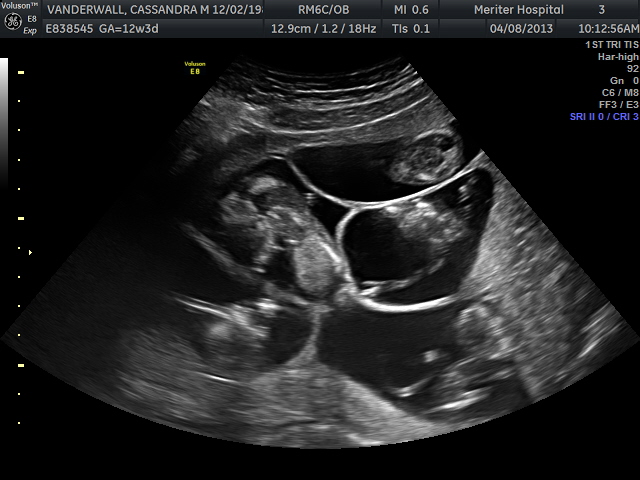
The second part of our visit today was focused on completing the 1st trimester screening which included anatomical assessments, heart rate assessments, nuchal scans, and numerical assignments. Overall, everyone is right on track. They are all just shy of 2.5 inches long, have all 4 limbs and strong heart beats between 150-155bpm. Also, the nuchal scan is an assessment of the thickness of the skin on the back of the baby’s neck. Greater thickness (> 2-3mm) is correlated with an increased incidence of congenital heart defects and Down syndrome. All of our little ones’ nuchal scans were <2 mm! They were also able to number each placenta for good, or so they are hoping. Based on the photo above, number 1 is on the bottom right, number 2 is in the center row on the right, baby 3 is to the left of baby 2, baby 4 is just below baby 3 and to the left of baby 1, and baby five is the cherry on top! All 5 have a distinct location, but have shifted a bit since the last ultrasound to provide themselves more room for growth. The ultrasound technician said that the placement of all of the placentas look great!

Cue “Eye in the Sky” by the Alan Parsons Project (a.k.a. the Chicago Bulls Intro Song)

And now all the way from Madison, Wisconsin, 12-weeks and 2.5 inches long the Vanderwall quintuplets!

When we were introduced to baby 1 at this visit, their little hand was right up to its ear, just like it was chatting on the phone. Our technician said it was probably calling the others to let them know Mom and Dad were watching :O) We deemed this one both our chatterbox and tattletale!

Baby 1
Baby 1

The next stop was to the three arranged in the middle. Starting from right to left: baby 2. It’s difficult to tell from the photo, but this one we think is going to be the tough cookie of the bunch. They had their fists raised just like a boxer and were kicking their legs like crazy. Little did we know, but those little legs were right up against baby 3’s placenta. We think we got to witness an epic battle of footsie!

Baby 2
Baby 2

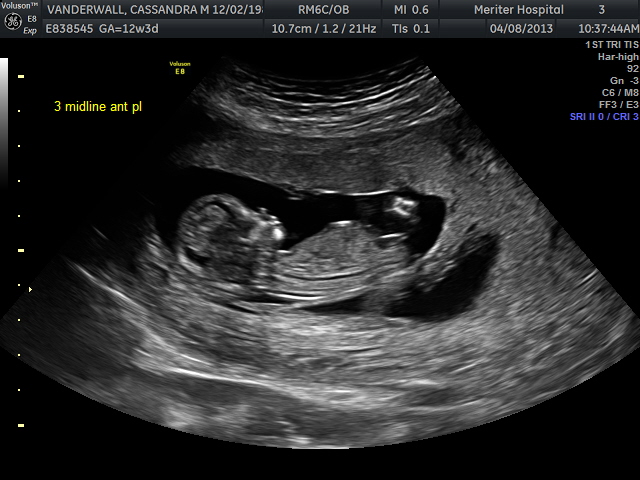
Moving to the left, the monkey in the middle, baby number 3. This little one couldn’t sit still for a moment. They looked like they were break-dancing with an impressive worm.
Baby 3
Baby 3

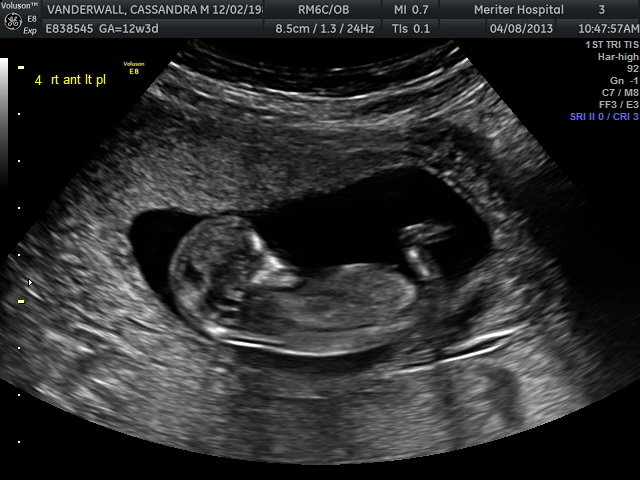
On the far left, is baby number 4. Who appeared to be the most mild mannered of the bunch. They were chillaxin’ with their little legs propped up and ankles crossed. They moved a little, but looked quite content watching the others.
Baby 4
Baby 4

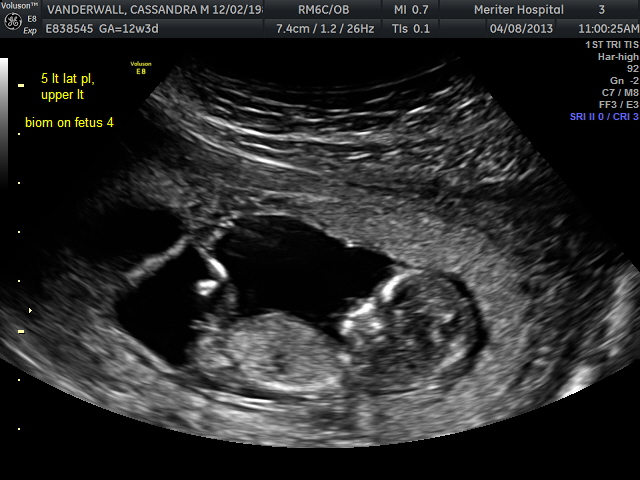
Baby number 5 was previously the baby they were most concerned about because they had nestled in near to the opening of the fallopian tube. They also were lagging a bit in growth last time we checked in. But, this time they scooted over a bit and have plenty of room to grow and they are tracking beautifully on growth. They are still the shortest of the bunch, but what they currently lack in length they make up for upstairs. The technician said this one had a beautiful brain! So, we’ve got a shorty with some smarty pants.
Baby 5
Baby 5

And those, folks, are the V-5! The next time we will get to see them is at 20 weeks! That is also when we will be able to assess their genders. So, please keep the prayers and positive thoughts flowing because these kiddo’s and their Mommy and Daddy have their eyes set on 34 weeks!

Eating for…Six

“Let food be thy medicine and medicine be thy food.”  -Hippocrates

Food-Is-Medicine

This is a statement I passionately believe in. Medicine is defined as “the science or practice of the diagnosis, treatment and prevention of disease,” and thus nutrition is also the science of the diagnosis, treatment and prevention of disease.

This is especially true when educating and counseling persons with chronic diseases, such as diabetes, high cholesterol, high blood pressure, kidney disease and the list goes on and on. Tweaks in what these persons eat on a daily basis can dramatically improve their disease state.

Many of you are probably waiting for the link to pregnancy, well here it comes. While I continue to believe in the power of nutrition, my view of food has shifted during pregnancy. I believe food during pregnancy is very similar to food for the elite athlete; it is its most basic form- fuel.

While dietary quality is of the utmost importance during both pregnancy and athletics, but quantity often is slightly more important. I have been intrigued by the amount of energy (Calories) required to grow and sustain life, let alone 2, 3, or 6 at one time.  The average adult woman needs approximately 1600 Calories per day and the average adult male needs nearly 2000 Calories per day. These amounts of course vary depending on an individual’s metabolism, body composition and daily physical activity. But, the average woman pregnant with one child needs approximately 300 additional Calories per day beginning in their 2nd trimester. However, this is not the case with multiples. This additional energy requirement starts in the 1st trimester and quickly escalates with each fetus:

  • Twins: 3,500 Calories
  • Triplets: 4,000 Calories
  • Quads: 4,500 Calories
  • Quintuplets: 5,000 Calories

One may be jumping for joy at this amount, because it’s like Thanksgiving everyday! Unfortunately, when you add in morning sickness, indigestion and limited belly capacity, this feat requires a bit of creativity.  Again, it is important to remember that quality is a close second to quantity and thus the type of Calories consumed is also very important.

The average dietary composition is 50-55% Carbohydrate, 25-30% Fat and 15-20% Protein. During pregnancy, this also shifts to approximately 40% Carbohydrate, 40% Fat and 20% Protein. Fat, primarily from unsaturated sources high in omega 3’s, like DHA, is critical for neurological development. Protein is known as the building block for life and food sources that maintain a complete amino acid profile, animal-based proteins, are ideal. The percentage of carbohydrates decreases during pregnancy, and my assumption for this decrease is two-fold: 1) To account for the increases in necessary fat and protein and 2) To limit edema, or swelling and bloating. Carbohydrates tend to pack on water has they are stored and extra L.B.’s from fluid tend to be unappreciated, especially later in pregnancy.

Overall, we know that nutrition is an individualized science and all of the energy goals have to be adapted to the individual. I believe the best outcome for measuring a person’s nutrition during pregnancy is maternal weight gain. Future mom’s of multiples are to gain an average of 2-2.5lbs per week beginning with week one, so that by 30 weeks mama has gained nearly 80lbs. Maternal weight gain is highly associated with fetal growth and gestational age, which we know are the two variables that often influence fetal complications.

So, for you “bump” lovers out there I will be sure to post a pic or two in the coming weeks along with some updated ultrasounds. Until then, hang tight…patience is a virtue (lol). And, for you nutrition geeks and foodies out there, much like myself, there will certainly be future posts on nutrition tips and meal planning for mom’s of multiples.

Five Buns in my oven

Written by: Cassie Vanderwall, MS RD CD CDE CPT

Woes and Wishes of the First Trimester

The first trimester poses something new with each week. The two-week wait presents great anticipation of finding out whether you have been part of the miracle of conception, as well as, the opportunity to strengthen your patience. In week three and four you begin to realize that your body is certainly not your own. As your blood volume begins to increase your heart rate, blood pressure and respiratory rate all tend to also increase, which left me exhausted and out of breath. It is amazing how nature has a way of slowing down even the busiest of all the bees. Then, come the GI (gastrointestinal or belly) woes. Bloating, indigestion and the beloved “morning” sickness all of which can be attributed to the hormones that are bouncing around like Flubber. My biggest woe has certainly been “morning” sickness, which for me has been 24/7 nausea.  I am very grateful that everything has stayed down, because we know every nutrient counts. I’d love to take a moment to share my tried and true tips for nausea.

The Do’s and Do Not’s of Morning Sickness

  • Do take 60-100mg of extra vitamin B6 everyday.
  • Do get your hands on ginger chews and ginger tea.
  • Do have your own stash of seltzer water and salty snacks on your person at all times…in your purse, car, desk, bag and table next to your bed.
  • Do get fresh air. For me, there was nothing like taking a walk around the block.
  • Do try a cold cloth on your forehead and back of neck.
  • Do stay hydrated with ice cold water.
  • Do purchase Seabands…they rock.
  • Don’t eat really fatty or smelly foods. The high fat foods take a long time to digest which delay transit time. Smelly foods (spicy foods, fish, etc) can trigger the nausea center in your brain, which usually doesn’t end well.
  • Don’t become constipated. If you can help to keep that train running you will prevent the intestinal traffic jam that can cause a nasty back-up. Focus on whole grains and fruits and vegetables that you can tolerate.
  • Don’t eat foods that don’t sound good. Food aversions are odd to me. Foods you love can quickly become foods that you cannot even think twice about. Don’t force it, save them for later because this too shall pass.
  • Don’t wait until you are hungry to eat. Establish a meal pattern, such as every 2-3 hours. An empty stomach is not your friend.

Alright, thank you for entertaining my list. Hopefully, some of you find it helpful. Onto a few more woes and wishes. During week 8, my nausea began to subside, which was scary for me because up until that point that’s how I knew I was not alone. My greatest fear at this point remains miscarriage. So, I am highly cognoscente of my signs and symptoms. This fear only escalated during week 9, this is a warning that if you’re grossed out by lady talk skip on to the next paragraph.  During week 9, I started spotting. It is really frightening to bleed during pregnancy, because I immediately think Aunt Flow has come for a visit and she doesn’t visit pregnant folks. I called my docs and they assured me that as long as it is not accompanied by cramping or back pain and does not increase in flow that everything is alright. I’ve heard a variety of reasons for bleeding during pregnancy, including:

  • Implantation
  • Placenta Formation and Attachment
  • Blood clots created during placenta formation
  • Bursting of blood vessels
  • Uterine growth and contractions

My plan is to keep a close eye on things and make a follow-up to ensure that everything is alright, so please be praying for this.

My greatest wish at this point is to make it to 32-34 weeks miscarriage free because I know at that point my babies have the best chance of a handicap free life.  I also hope and pray that I can create the ideal environment in my belly for their growth and development.

All of these woes and wishes, hit me pretty hard on the way to work yesterday. Then, I was blessed by a song on the radio; “I need you now, how many times” by Plumb. Amazing song and exactly what I needed to hear.  I hope it inspires you, too!

Written by: Cassie Vanderwall

Visit to the High Risk Clinic

Keep Calm and Choose Life

It has taken me over a week to process our first visit to the perinatal high-risk clinic. Frank and I went into the visit excited and prepared to askour long list of questions about how we can make this pregnancy the most successful it can be. We anticipated a thorough discussion on treatments, tests and procedures as well as detailed instructions for each trimester. Much to our dismay, this is not what occurred.

The visit started off wonderfully. We had our second ultrasound and had the opportunity to see all five of our blessings at appropriate lengths and with strong heartbeats. The ultrasound tech was amazing! She walked us through everything we were looking at for each of the fetuses. It was breath taking!

Frank and I were so encouraged after the ultrasound that we decided to launch our announcement and once again we were overwhelmed by the love and support from everyone! We don’t have words to describe how thankful we are!

We then headed over to the consultation room to meet our maternal and fetal medicine specialist and his fellow. Even within the first few minutes I sensed tension that you could have cut with a knife. The doctor also did not congratulate us, but hopped right into reviewing my medical history and highlighted each condition that put this pregnancy at risk. Then, he decided to transition to the stat list and read the probabilities for each of the chronic and acute disabilities and conditions. I made it halfway through the list and burst into tears. The fellow kindly stopped and was very apologetic. He just kept saying, “Oh no, Oh no… I’m so sorry.” I sensed his compassion at this point, but unfortunately the floodgates had already opened. The specialist quickly took over and the fellow excused himself; I’m fairly certain he went out into the hallway to cry because he came back with tear-stained cheeks.

I knew where this conversation was going. Our perinatologist then walked us through additional studies on the risks of quintuplets and the benefits of multi-fetal reduction. I must admit his approach was much softer than our first doc, but it was clear he was on a mission. He told us that there was a chance that all five of our children could be born with cerebral palsy. This really hit home; would I be able to mother 5 children with several disabilities? My immediate answer was yes, if that’s what I was called to do.

He also shared several studies that highlighted the importance of gestational age and birth weight. There is no doubt that I comprehend the risks we are facing of CP, compromised lung function, IVH, blindness, deafness and the list goes on and on. But, as a mother-to-be I cannot help but be optimistic and fight for these little ones. I have catalogued the research articles that were shared by the docs below, and would love others’ opinions. But, I have also found countless studies that demonstrate that medical technology today provides strategies to prolong gestation and decrease the risk of neurological abnormalities and respiratory complications.  If any others have additional research studies that have been pivotal to their care, please do not hesitate to share.  My hope now hinges on the fact that I could make it past 32 weeks. For quints, this would resemble a birth at 28 weeks, which continues to pose a risk, but according to the articles the risks tremendously decrease for (Condition, probability):

If we can make it to 34 weeks, the probabilities of RDS decreases to 55%, IVH to 2%, Sepsis to 11% and NEC to 15%.  So, our Doom and Gloom conversation, part II, finished up on a very sad note. Frank and I drove home in a haze of what if’s, statistics, and desperately sought some good news. Our next visit back to this clinic is not until our 2nd trimester, or one month. Until then, we continue to take one day at a time doing all that we can to prepare mentally, physically, emotionally, spiritually and of course financially to parent five beautiful babies.

Research Articles:

Multiple Gestation associated with infertility therapy: an American Society for reproductive medicine practice committee opinion

Contemporary outcomes with the latest 1000 cases of multifetal pregnancy reduction (MPR)

Estimation of neonatal outcome and perinatal therapy use

Long-term Medical and Social Consequences of Preterm Birth

Long-term family outcomes for children with very low birth weights

Multi-fetal Pregnancy Reduction, Committee on Ethics

Management of High-Order Multiple Gestation

High-Order Multiple Gestations

The Case Against Multi-Fetal Reduction

Determinants of Gestational Weight Gain

Outcomes in Young Adulthood for Very-Low-Birth-Weight Infants

Written by: Cassie Vanderwall