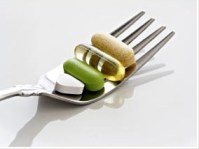
 Registered dietitians stand behind the mantra of “food first;” which means skip the supplements, as long as, you can obtain what you need from what you eat or drink. I have also always practiced and preached this stand point, but now I can no longer obtain enough of certain vitamins and minerals to reach the recommended daily values.
The Institute of Medicine (IOM) publishes dietary reference intakes, or DRI’s, for most vitamins and minerals. This administration individualizes the values based on gender, age, pregnancy and lactation. For example, it is recommended that a 30 year old woman strive for 18 mg of Iron everyday, however if that woman is pregnant she now needs 27 mg. As one can imagine the needs for moms-to-be of multiples are even greater, and while the IOM does not have current recommendations for these individuals, such as myself, the research literature does. I have obtained most of my micronutrient goals from Dr. Barbara Luke‘s and Dr. John Elliott‘s publications, which give specific recommendations for the following vital amines (vitamins) and minerals.
Vitamin B6: This water soluble vitamin, like the other B-Vitamins, is critical for the metabolism, or breakdown and use, of protein, fat and carbohydrates. It also helps to form the developing brains and nervous systems of all the growing babies, while also playing a role in the formation of new red blood cells, antibodies to support the immune system, and neurotransmitters, which are those happy hormones such as serotonin, dopamine, and DHEA.
It can be found naturally in chicken, fish, pork, chickpeas, and baked potatoes. The DRI is 1.9 mg, but people can tolerate up to 600 mg without side effects. The literature also supports the use of vitamin B6 to help control morning sickness/nausea with recommendations of 25mg, three times per day along with Vitamin B12. Although, the mechanism of how this works remains unknown, my hypothesis is that it alters pathways in the vomiting center of the brain by increasing serotonin.
Folic Acid (Vitamin B9): This B-vitamin is one of the most popular pregnancy vitamins, partially due to the movement to fortified all refined grains in the United States to insure adequate folate to prevent neural tube defects during pregnancy. Most prenatal vitamins have 400-800 mcg of this vitamin, which is the DRI for a singleton and multiple pregnancy, respectively. Thus, it is evident that folate plays a critical role in the neural development of the babies, but also is required for DNA synthesis and aids in cell division. Also, like vitamin B6 it helps in the formation and maintenance of red blood cells to prevent anemia. Good sources of folate include dark leafy green vegetables, beans and legumes, egg yolk, sunflower seeds and liver.
Vitamin B12: B-12 is another powerhouse for neural and blood development and maintenance. It also helps to regulate DNA synthesis and can be found in every cell of the body. It can be found naturally in animal-based foods (meat, chicken, fish), dairy and eggs, as well as, from fermented teas such as kombucha. The DRI for B12 is 2.6 micrograms. As mentioned previously, Vitamin B12 can also be taken in conjunction with vitamin B6 for morning sickness. The recommended doses vary from 4 mcg per day up to 25 mcg, two times per day.
Vitamin D: This fat-soluble vitamin is unique in that in can be synthesized in our skin with the help of the sun. Unfortunately, for folks in the Midwest there is only adequate sunlight in a small window of the year. Therefore, most are commonly deficient in this vital amine. The DRI for vitamin D is 200 IU, however the human body can make 10,000 IU in about 20 minutes in the sun, which tells us our bodies can handle much more. Some research literature suggests that some women need up to 4,000 IU to obtain adequate serum levels during pregnancy. Vitamin D is not found in very many foods, but can be found in mushrooms, eggs, and fatty fish. It is also added to some foods such as in the case of milk.
Most people know that vitamin D helps to support bone development and maintenance by increasing the absorption of calcium and magnesium from the gut. It also plays a role in preventing cardiovascular disease, multiple sclerosis, and some forms of cancer.
Iron: Iron is commonly supplemented during pregnancy and is the cause of several unwanted side-effects, such as nausea and constipation, but it is important in providing oxygen-rich blood to both mom and babies. Most moms-to-be need more than the DRI (27mg) for iron to maintain adequate amounts. The research that I have reviewed recommends 325 mg of iron daily for moms of multiples.
Iron can be found in red meat, liver, chicken, fish, beans, leafy vegetables and molasses. But, typically a supplement containing Iron sulfate is recommended. I encourage, and take myself, a slow releasing version of iron. SlowFe is a common name brand for this type. I also always take iron with vitamin C to improve absorption, and avoid taking it with calcium-rich foods which tend to inhibit absorption and utilization.
Calcium and Magnesium: These minerals are the super heroes for building and maintaining mom’s bones while constructing baby’s skeletal structure. The DRI for calcium is 1,000 mg, however the research literature recommends closer to 2,000 mg and the DRI for magnesium is 36o mg but again the literature suggests 1,200 mg per day. In addition to calcium’s bone building role, it also acts as a signaling messenger for some hormones and a co-enzyme, or “right-hand man” in blood clotting. Magnesium also has significant roles in over 300 bodily reactions, including muscle and nerve function, maintaining a steady heart rhythm and regulating blood sugar and blood pressure. There is also a growing body of research on the use of magnesium sulfate to prevent pre-term labor. It is usually administered intravenously (via IV) in boluses of 4 to 6 g over 30 minutes and then maintained at 1 to 3g per hour to achieve serum levels of 5 to 8 mg/dL. This level is considered therapeutic at inhibiting, or stopping, myometrial (middle layer of the uterus) activity a.k.a. contractions. Needless to say, food sources of calcium and magnesium, as well as, supplements are very important for moms of multiples. Calcium is found in high amounts in tofu/soy, green vegetables, sardines, molasses and of course dairy products. Magnesium is found in wheat bran, dark leafy green vegetables, nuts and seeds and beans and legumes.
Zinc: This mineral is required for an assortment of processes in the body. It is necessary for the activation of over 100 enzymes, and plays a large role in immune function, protein and DNA synthesis, cell division and wound healing. Therefore, one can see how it helps to support normal growth of the fetus during pregnancy. The DRI for zinc is 11 mg and daily intake is very important because it is not stored in the body. This mineral is another one that researchers believe is required in larger amounts. It is recommended to strive for 45 mg per day when preparing for a multiple birth.
So, those are the elite eight! Or, the eight micronutrients that are touted for playing very crucial roles in the maintenance of mom and growth and development of babies during a multiples pregnancy.
There is one more nutrient, a macronutrient, that recent research has pin-pointed as another key to neural development during pregnancy- DHA. Omega 3 fatty acids have exploded in popularity due to their powerful role in reducing inflammation, or putting out the fire, in the body. This decrease in inflammation can be attributed to two of the omega-3’s found in fatty fish, Docosahexaenoic acid (DHA) and Eicosapentaenoic acid (EPA). DHA, specifically, is now being added to some prenatal vitamins due to studies noting that DHA can help reduce risks of poor retinal (eye) development and poor cognitive development. The International Society for the Study of Fatty Acids and Lipids currently recommends 300 mg per day of DHA for pregnant and lactating moms. A new article published in the American Journal of Clinical Nutrition stated that mom’s who took 600 to 900 mg of DHA per day had longer gestations, bigger babies and longitudinal data points to better cognition for the children in their preschool years.
Despite obtaining 150-200% of the DRI for the nutrients listed above, supplements are still a critical part of my daily dietary regimen. If you’re a mom-to-be and have questions, or recommendations, about the information above, please contact me.
Written by: Cassie Vanderwall, MS RD CD CDE CPT