
Real [small] talks matter more for busy families
Busy weeks tend to bring more stress, more feelings, and less time to process any of it. That’s exactly when our kids need a soft place to land.
In my experience, kids often open up when the pressure is low and the moment is ordinary. Not at a scheduled “we need to talk” sit-down or family meeting, but in the middle of folding laundry or driving home from practice.
And connection isn’t just a nice extra. It’s part of how kids handle hard things. A large study published in Pediatrics followed more than 14,000 young people from adolescence into adulthood. Those who felt strongly connected to both family and school as teens had 48% to 66% lower odds of several health risks as adults, depending on the outcome, including drug misuse and violence. That’s an association, not a guarantee. But it tells me the small, everyday moments of connection we build now are worth protecting.
Find the time you already have
You probably have more pockets of time than it feels like. A few of my favorites:
- Car rides.
Side by side, no eye contact required, and nobody can walk away mid-sentence. For a lot of kids, that takes the pressure right off. If you’re like us and have extra ears, it can be a bonus because it adds to the discussion. It also can double the impact and influence. With siblings listening, car talks are less private, so choose the topic with care. It can be a great time to talk through pregame nerves, promote pre-practice visualization or yummy ways to refuel after games. I’d steer away from anxiety-provoking topics like substances, changing bodies or big feelings until it’s a solo ride.
- Meal prep and cleanup.
Hands busy, conversation easy. A snack after practice counts too. This is a great time to unpack why you chose to serve what you did or to invite your family to help meal plan for the next day. You can hear which meals and snacks are a big hit and those to drop from the rotation.
- Bedtime check-ins.
Even two minutes at the edge of the bed can turn into the best talk of the day. Yes, this is when energy is low. Yes, I often need a personal pep talk before I make the rounds. Yes, I continue to commit to “tucking” my kiddos in because these two to 20 minutes are often the only time I get to give them where they know they have my attention. It is also when they start to let down their guard after being tough all day. So, while it’s hard, it’s worth it.
- Walks, errands, and waiting rooms.
The time we usually fill with our phones can become time to connect. Making our way through the grocery store, running errands, and waiting in line are my favorite times to have my family nearby. While it’s unlikely we’ll dig into our deepest darkest secrets in public, these moments build memories, skills and trust.
One-on-one time in a busy (or big) family
When you have more than one child, group conversations can easily become the default. Family time is wonderful. But some things a child will only say when they have you all to themselves. Additionally, when family meetings are the only time for connection, it is easier for hard topics and unnecessary secrets to stay hidden. Big voices often dominate the conversation and it can be hard to share when siblings are near. The CALM Kids Workbook was born out of the need to have individual attention within a group effort. This way we can rotate through one-on-one and share as a group. In the end, we all unpacked the same topic and all were seen and heard.
Questions that open the door
“How was your day?” usually gets “fine.” A slightly different question can get a whole different answer. Here are a few we like:
- “What was the best and hardest part of today?”
- “What is something you learned today?”
- “Who did you complement today?”
- “What’s something you’re looking forward to?”
- “What’s something you’re worried about?”
- “Is there anything you want me to know?”
Then comes the part that’s harder than it sounds: listen more than you fix. Reflect back what you heard (“It sounds like that really frustrated you”) before offering any advice. Kids keep talking when they feel heard.
Staying calm and present in those moments takes practice, especially at the end of a long day. Our steadiness gives them room to keep talking.
When the talk is about something hard
Not every real talk is about the best part of the day. Sometimes it’s about friendships, loss, big feelings, or the topics that make us as parents a little nervous.
- Stay steady. Your calm helps them stay calm.
- It’s okay to pause. “Let me think about that, and we’ll talk more tonight” is a perfectly good answer. Just make sure you come back to it.
- Let a book do some of the heavy lifting. Books can make hard topics easier to start. Life’s a Battle and We Will Win, a book I’m proud to be a contributing author of, gives families words for the hard things and the hope to face them together.
- Give kids their own tools. The CALM Kids Workbook gives kids tools for big feelings before, during, and after a hard conversation.
One hard topic worth starting early: Substance use
One of the hard topics I think about a lot as a mom of teens is alcohol and other substances. If you’re not sure how or when to start, I really appreciate the Wisconsin Department of Health Services’ Small Talks program for talking with kids about alcohol and other substances.
Here’s what Small Talks shares:
- Substance use isn’t harmless fun. School-aged kids are going through a critical period of physical and emotional growth. Using substances like alcohol, cannabis, commercial tobacco, heroin, and methamphetamine during this time exposes their developing brains, lives, and mental health to serious, even deadly, consequences.
- Start early and keep going. DHS recommends starting to talk with kids about the impacts of substance use at age 8 and continuing to talk as they grow up.
- Keep it small. Small talks are short, casual conversations that can happen anytime, anywhere. (Sound familiar? The car, the kitchen, bedtime. The same pockets we already talked about.)
- Model it. DHS calls being a positive influence on youth the best way to help them make the right choices, especially when it comes to substance use.
The site also has youth substance use facts, tips for starting the conversation, video stories from Wisconsin parents and other caring adults, and ideas for what adults can do beyond conversations. It’s a Wisconsin program, but the guidance is helpful for any family.
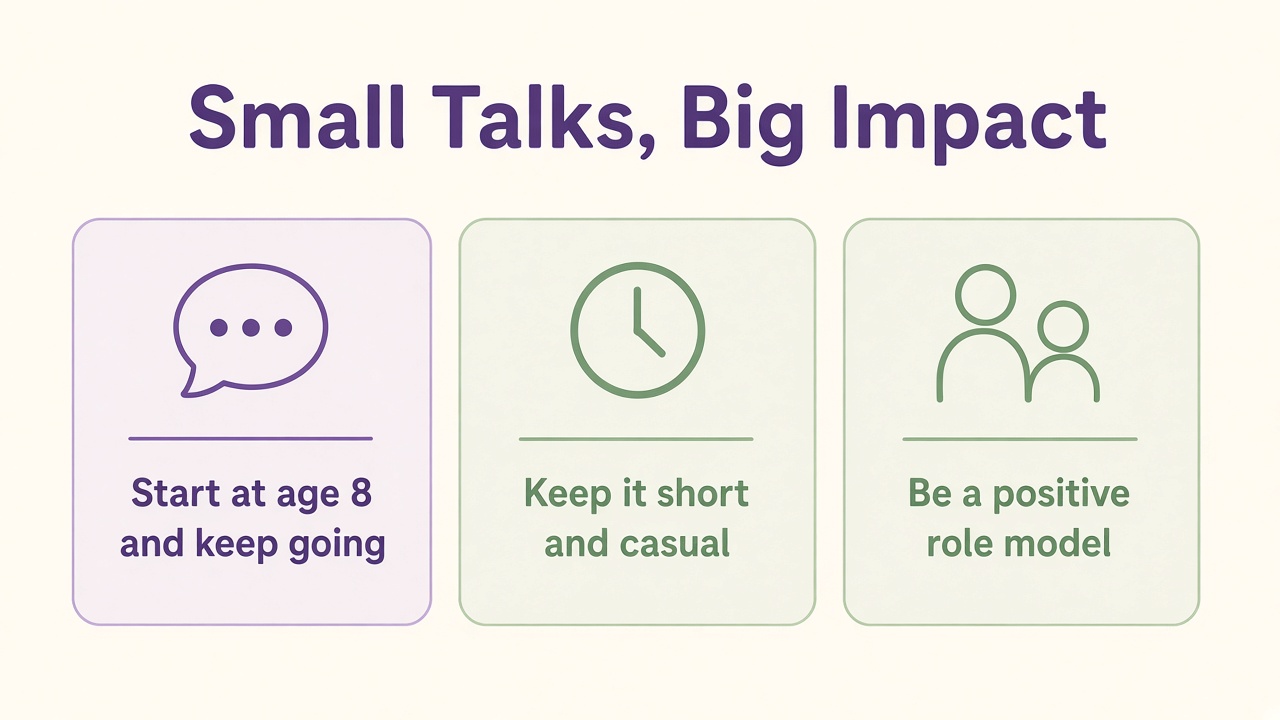
What I love about this approach is that it takes the pressure off. You don’t need one big, perfect “talk.” You need lots of small ones, over years.
Bottom line: Make it a rhythm, not a rescue
It’s easy to save connection for the moments when something goes wrong. A steady rhythm works better.
- Pick one small weekly ritual for connection. A walk, a treat, reading together. Keep it simple enough that it actually happens.
- Protect it during busy weeks. That’s when it matters most, and also when it’s easiest to skip.
When connection is already part of the week, the hard conversations have somewhere to land.

If you’re local, I’d love for you to join us for Family Fun Night on Wednesday, Nov 4, from 6 to 8pm at the Sun Prairie Library. We’ll be featuring Life’s a Battle and We Will Win, and it’s a fun way to start real talks as a family. I hope to see you there!

