
The calendar on the kitchen wall is full. Concerts, practices, class parties, and the family gatherings are all stacked into the same few weeks. Layer on top winter break from school where you already know hangouts, sleepovers and random requests to break the boredom will arise. The grocery list keeps growing, and somewhere along the way you realize you’ve been running on coffee and leftovers since Halloween.
The holidays can be beautiful and crammed at the very same time.
Here’s the thing about burnout: it rarely arrives with a crash. It shows up quietly. A shorter fuse. A skipped lunch. A bedtime that keeps sliding later. If you’re noticing those, please hear this: That’s not failure. It’s information.
What holiday burnout looks like in a real house
- Snapping over socks (and knowing it isn’t really about the socks)
- Forgetting to eat until the kids do
- Lying awake making lists even lists for what you wished you had accomplished
- Saying yes to every invitation
- Feeling guilty for wanting a little quiet
You can’t pour calm into your kids from an empty tank. As I wrote in the Holiday CALM mini kit, “Our children can sense our anxiety before we even open our mouth.” That’s why this season’s plan starts with you. I dig into preventing caregiver burnout in The Long Haul.
CALM, turned toward you
Most of the time, we point CALM at our kids. This season, try pointing it at yourself first.
C: Curiosity Over Control
The holiday version is “Before you fix it, wonder about it.” That goes for you, too. What’s underneath your 5 p.m. short fuse? Hunger? The cacophony of sound coming from the living room? No break since 6 a.m.? The short fuse is a message, not a verdict.
A: Anchor with Routine
When the days go topsy-turvy, keep one or two anchors a day for the kids: the same bedtime song, the same goodnight words, wherever you sleep. Then, choose one anchor for you. A real breakfast. Ten quiet minutes with a cup of coffee that’s still hot. A walk around the block where you can actually breathe deeply.
L: Lead with Language
Say it out loud so your family learns from it: “I’m at a 4 right now. I need five minutes, then I’ll be back.” Use the same 1 to 5 scale your kids use. When they hear you name it, they learn they can name it, too. It also lets them know that 1) you’re human, 2) it’s ok to ask for help and take a break, and 3) you will be right back.
M: Model Emotional Regulation
Your slow breath is the first thing your child borrows. This doesn’t mean staying perfectly composed. What matters most is showing how to pause, recover, and move forward. Sharing our calm amidst the chaos is better than the best words we could muster up for our family.
Not perfection. Just presence.
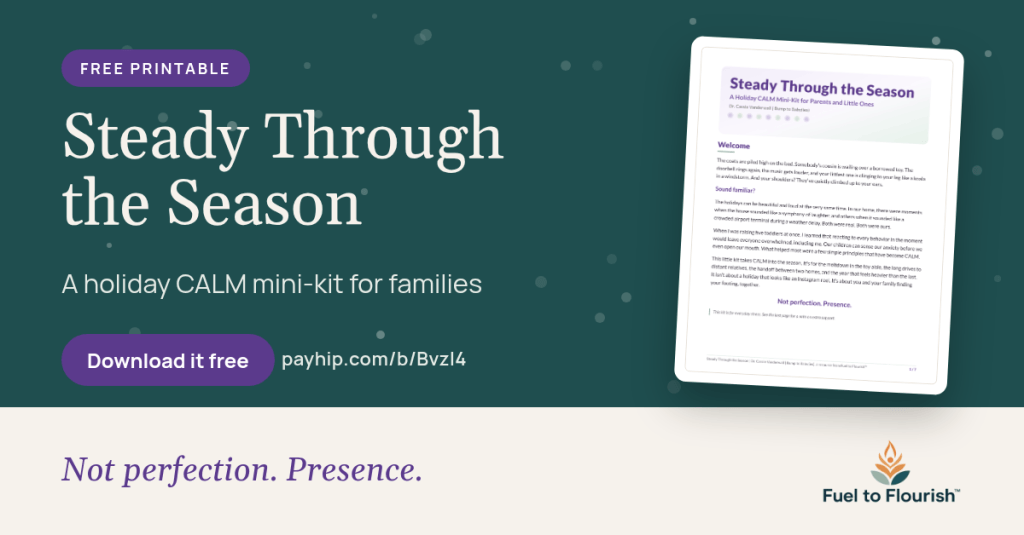
Free for your family: Steady Through the Season
My new holiday CALM mini-kit brings everything above to your fridge: the four CALM steps in holiday form, four real holiday moments walked through (the crowded-party meltdown, the gift that wasn’t “the one,” a travel day between two homes, and a heavy season), two cut-out calm-down cards for kids (My Calm Card and My Feelings Check-In), a Color Me! coloring page, and a quiet page just for you. Print what helps and skip what doesn’t.
Food that keeps everyone steady (without guilt)
- Feed everyone before the party. A snack before gatherings and long travel days goes a long way, because hungry, tired kids (and hungry, tired parents) tend to melt down faster. Pair carbs with protein for a snack that lasts like Fruit with Nuts or Nut butter, Crackers and Cheese, or Half a Sandwich.
- Pack a “base camp” snack bag. Keep one in the car for gatherings and travel: crackers, nuts, meat sticks, fruit cup or fruit pouch or two, and water bottles. Be sure snacks are safe for children <4y so watch nuts and meat sticks as potential choking hazards. When dinner runs late, you’re covered. Little ones under 4? Skip whole nuts, meat sticks, and hard candy like candy canes, spread nut butter thin, and save snacks for when they’re sitting up with a grown-up watching, not riding in the car seat.
- Let treats be part of the season. Cookies and candy canes belong here, too. Skip the “good food, bad food” talk at the table. Holiday food is something to enjoy together, not something to earn. Food is way more than energy for our body. It is a celebration of our culture, traditions and often where memories are made.
- Choose one anchor meal for packed weeknights. A sheet-pan or slow-cooker dinner you can make on autopilot. Even better is finding a meal that’s easy to make extra of to freeze as a gift to your future self.
Rest and rhythm when the calendar gets full
- Protect bedtime anchors on travel days. If you’re splitting the holiday between two homes, pack the anchors along with the pajamas: a comfort object, a pillowcase, a familiar song for the drive, and the same goodnight words.
- Say no to one thing. What can you set down this season? An expectation, a tradition, or a “should.”
- Try a weekly family check-in. A quick round-robin at Sunday dinner. Kids answer “How strong are your feelings?” from 1 (a little) to 5 (really big). Then, they name the feeling and the cause. Grown-ups answer “How full did your day feel? Roomy, Busy, Packed, Overflowing.” Same idea, two sizes. The “How strong is my feeling?” card is inside the free kit, ready to cut out.
When it’s more than holiday stress
The tips here are for everyday stress. If things feel like more, please reach out to your own doctor or a licensed professional. Reaching out is a strong thing to do. In the US, you can call or text 988, or chat at 988lifeline.org, to reach the 988 Suicide & Crisis Lifeline.
A blessing for the season
May you find small pockets of quiet in a loud season. May you speak to yourself as kindly as you speak to your child. And may you remember that steady is enough.
Grab your free copy of Steady Through the Season: payhip.com/b/Bvzl4
Browse the rest of the store at payhip.com/FueltoFlourish.
Ready for the full practice? When you’re ready to go deeper, it lives in The CALM Parenting Workbook. For your kids, pair it with The CALM Kids Workbook.
Holiday book bundles are coming next week. Watch for them here on the blog.
Want the science behind the steady? On my other blog, Fuel to Flourish, I write about the why: how stress, sleep, food, and energy work together in the body, especially in midlife. This week’s post, The Long Haul, explains what a long season of caregiving does to your body and the small anchors that help. Subscribe to Fuel to Flourish

